Quantum technologies have the potential to transform our capabilities across sensing, navigation, timing, information security and communications. But what does it actually take to move quantum from the lab into the field?
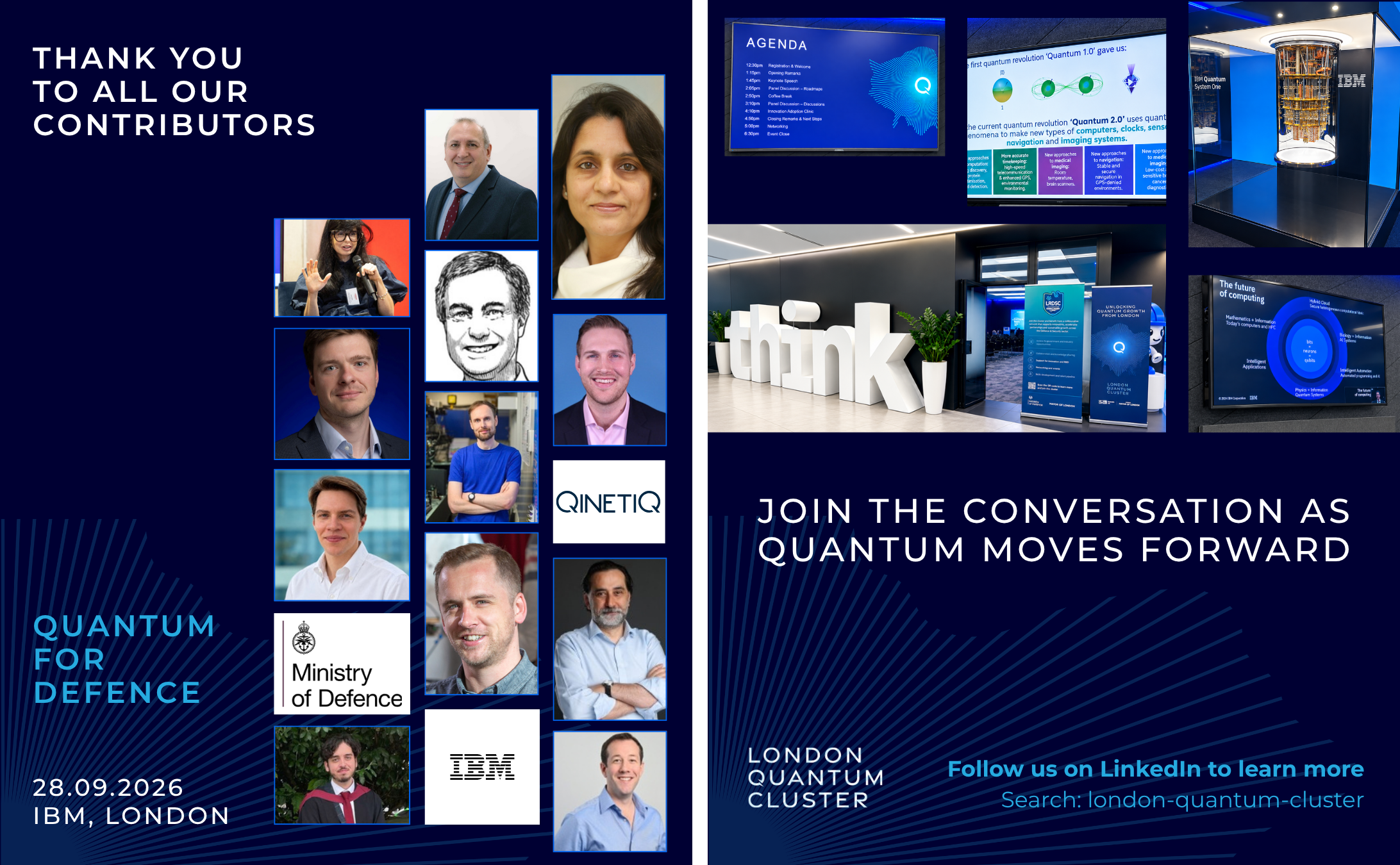
This was the focus of “Quantum for Defence: Aligning Technology, Policy and Procurement”, co-organised by the London Quantum Cluster and the London Regional Defence and Security Cluster, and hosted by IBM.
Bringing together delegates from defence and security, academia, venture capital and industry, the event explored the latest developments in quantum technology and how to translate promising prototypes and trials into real-world adoption.
Several themes stood out:
🔹 Start with the why, not the technology
For prospective defence and security adopters, the point is not whether a solution is quantum. What matters most is the problem it solves, the benefits it delivers, and the operational advantage it could bring.
As Robert Turnbull-Hall of QinetiQ put it, the focus needs to be on the why: Why should you invest, what needs does it meet, and where is the demand? At the same time, buyers need to clearly articulate their problems and requirements so that innovators can develop solutions around them. One striking example was the need for resilient positioning and navigation: Joe Cotter highlighted the potential economic impact of losing GPS, estimated at approximately £1 billion per day in disruption to the UK economy.
🔹 Innovation needs to be tested in the field
The journey from successful lab demonstration to deployable technology requires much more than technical performance.
We heard examples of quantum-enhanced positioning and navigation being tested at sea, alongside efforts to develop portable quantum sensors for applications including rail and aviation. Testing in real environments, with end-users and as early as practical, is critical to understanding how technologies perform as part of real-world systems and deployable solutions.
🔹 Quantum won't operate in isolation
Quantum computing will operate alongside classical computing, with AI and machine learning helping to determine how workloads are distributed between different types of computing. Likewise, quantum sensing, PNT and communications will need to integrate with existing infrastructure and technologies.
The opportunity therefore lies not just in developing individual quantum capabilities, but in understanding how they integrate with the systems of the future.
🔹 Adoption relies on strong connections
Testing and evaluation facilities, standards, skills, investment and procurement all play a role in moving innovation towards deployment. Chris Cox from NPL remarked thamuch of this infrastructure already exists: the challenge is making sure that it is visible and easily accessible. The pathway to adoption depends on strong connections between innovators, customers, investors, infrastructure and procurement. 🤝
As a quantum-enabled future comes into view, it’s clear that people and relationships will play an equally important role. The London Quantum Cluster helps create those connections - bringing science, capital and talent together to catalyse innovation into capability and create value for the economy and society.
Thank you to everyone who contributed to a fantastic discussion, and to IBM for generously hosting!